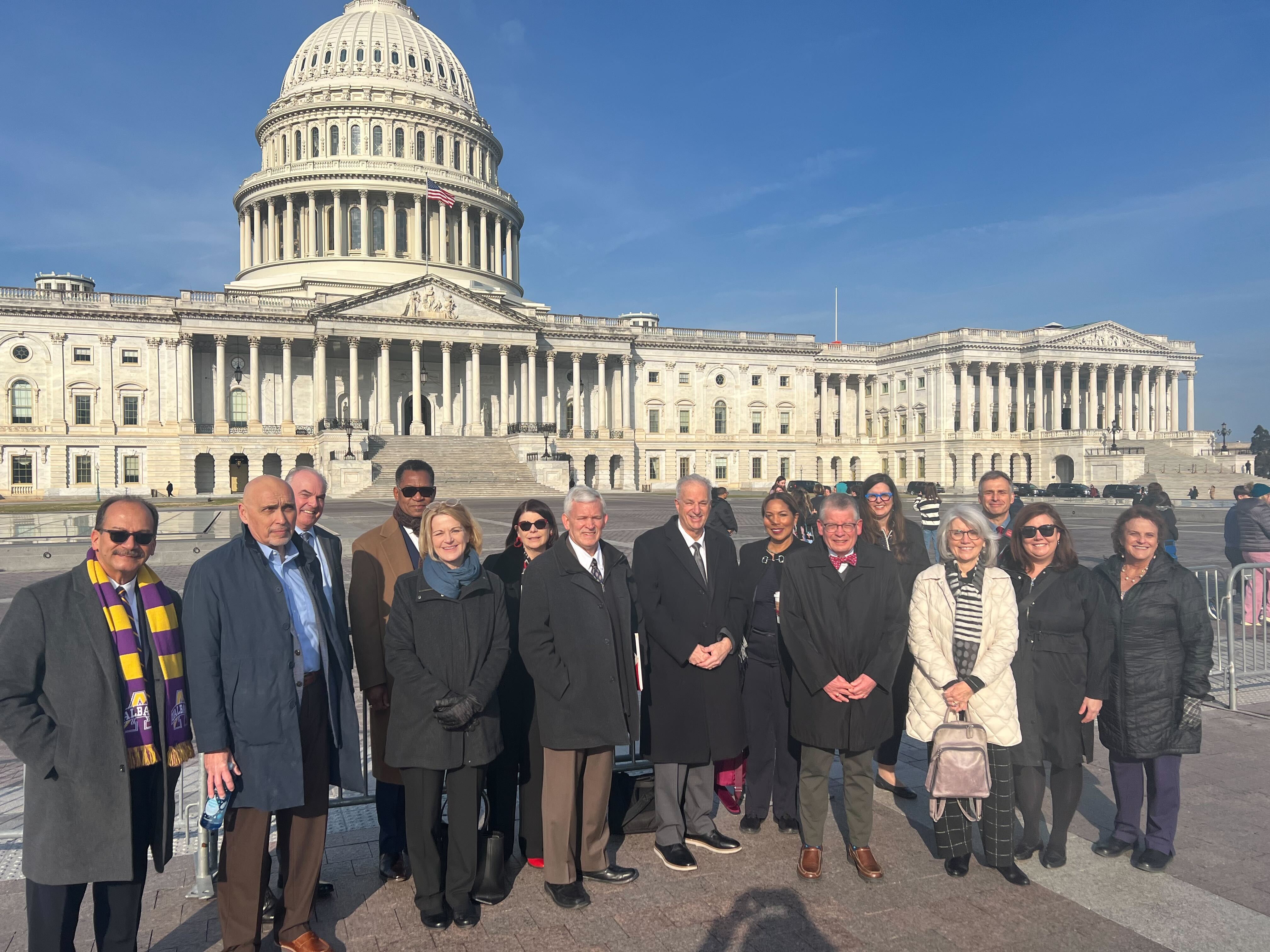
On March 4, 2025, Campus Compact hosted the 2nd annual Presidents' Policy & Impact Summit on Capitol Hill. During the day, presidents from institutions across the country convened for strategic discussions with key policymakers, agency leaders, and congressional staff regarding the role of higher education in civic engagement, workforce development, and public impact research.
Prior to the Summit, the Campus Compact Board of Directors met on March 3rd for strategic planning. They ended their day hearing from several current and previous Newman Civic Fellows.
- Lauren Patrick, George Washington University, Current Newman
- Lily L’Oiseau, Goucher College Current Newman
- Alex Edgar, 2023-2024 Newman alum and now Gen Z Civic Leader, Youth Engagement Manager, Made By Us
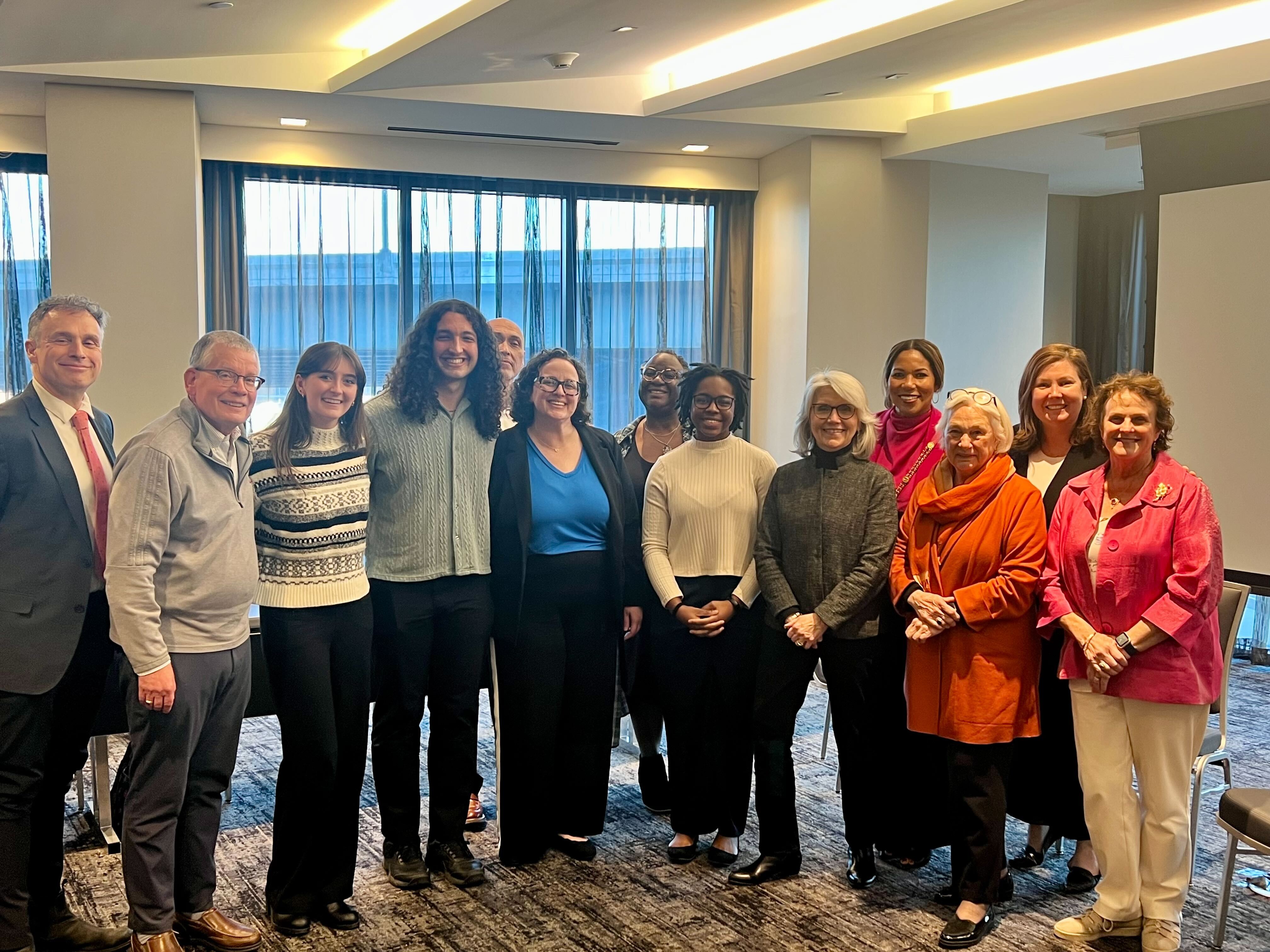
Several Campus Compact Board Members met with current and recently graduated Newman Civic Fellows.
Tuesday’s summit focused on building relationships and shaping federal priorities for 2025 and beyond.
Navigating Washington in a Climate of Uncertainty
Compact’s federal affairs team, Washington Navigators, provided an overview of Executive Orders, workforce reductions, agency guidance, ongoing court cases, and the legislative outlook affecting higher education. They highlighted that with Republican control of the White House, Senate, and House of Representatives, President Trump’s agenda of tax cuts, deregulation, immigration reform, energy independence, trade, elimination of social programs, and changes to the federal civil service was going forward with little resistance from Congress. Funding for agencies of interest to Campus Compact, including the Department of Education, is extremely uncertain. While the full-year Continuing Resolution passed by Congress on March 14 does provide some stability, the outlook for next year's budget is very much up in the air with cuts possible to programs like AmeriCorps and Federal Work Study.
Washington Navigators emphasized that higher education faces challenges on several fronts, including research dollars, endowments, diversity, equity, and inclusion, and the public value of universities in their local communities. Yet, despite these challenges, the Compact federal agenda remains vital and, in many ways, more important.
Our voice defending critical programs will be needed in the weeks and months ahead and we believe opportunities to shape legislation around civic and community engagement remain necessary.
The Senate Outlook on Civic Education and Engagement
Ms. Katie Pannell, Health and Education Policy Advisor, the Office of Senator Chris Coons (D-DE) joined us for a discussion of the Senate outlook on civic education and engagement. Senator Coons, a member of the Senate Appropriations Committee, is the Co-Chair of the Senate National Service Caucus and late last year introduced the AmeriCorps reauthorization bill—the Promoting Service through AmeriCorps (PSA) Act. We discussed the importance of AmeriCorps and public service pathways and the need, now more than ever, to ensure our students and alums can serve and help us address our most critical issues.
Mr. Marshall Burkhardt, Legislative Assistant, Office of Senator Andy Kim (D-NJ), also joined the group. Senator Kim has long championed civic education and service learning, and we are excited to work in partnership with his Office to explore new ways to support and advance these efforts.
Update from the Senate Appropriations Committee
Mr. JT Jezierski, Chief of Staff to Senator Shelley Moore Capito (R-WV), shared insights on the senator’s leadership as Chair of the Appropriations Subcommittee on Labor, Education, Health, and Human Services. In this role, Senator Capito plays a key part in overseeing budgets for the Department of Education, the Corporation for National and Community Service, and other critical programs that impact communities nationwide. We discussed the critical role universities play in their local communities and the necessity of helping to translate that local impact effectively.
House Appropriations Perspective
The Honorable Frank Mrvan (D-IN) representing Northwest Indiana joined the group and has been a strong advocate for investment in research and development. Since joining the House Appropriations Committee at the start of the current Congress, he has served on subcommittees that oversee much of the federal government’s support for innovation, including funding for the National Science Foundation, NASA, NIST, and the Department of Energy. Congressman Mrvan spoke about the importance of higher education as both a community and education anchor. He encouraged continued efforts to educate future leaders and partner with communities for a positive impact.
Key Takeaways:
- Amid such uncertainty, we must stay united around our common purposes and values
- We must do a better job of translating our local impact at a national level
- Our institutions are important engines for social and public good and we need to protect the programs and funding that make it feasible to fulfill that important work
- Partnerships are essential, we need to work together as a sector to make an effective case for continuing to invest in AmeriCorps, Federal Work Study, and community-driven programs.
- We need to develop clear communications as a Coalition and individual campuses around the impact of federal funding cuts on preparing the next generation of leaders.
- Campus Compact is needed more than ever as a leading voice for higher education’s civic and community engagement role in regions, states, and communities across our country.