The Art of Conservation: A Game Art Student’s Journey With Campus Compact EnviroCorps Service
At Miami Dade College (MDC), the mission is clear: “To serve as an economic, cultural, and civic leader for the advancement of our diverse global community." Across eight campuses, a student body of over 100,000, and a web of partnerships involving local organizations and initiatives, MDC prioritizes community engagement as a core value. Through the Earth Ethics Institute (EEI), the mission translates into becoming a changemaker for Earth Literacy—the idea that every student, regardless of their major, should understand their connection to the planet.
But what does that look like when you trade art supplies for a pair of gardening shears?
Meet Bee, a rising third-year student at MDC’s Wolfson Campus. While her days generally involve the technical precision of her Animation and Game Art classes, her heart—and her AmeriCorps service with Campus Compact EnviroCorps (CCEC)—is firmly planted in the soil of South Florida.
From Pixels to Plants (and Vice Versa)
Bee’s path to CCEC service wasn’t a straight line. Like many students, she spent her first year exploring. She initially dove into anthropology and archaeology before realizing something felt… incomplete. Or missing. A core part of her not tended to.
“It wasn’t for me,” she reflected. “I decided to go back to my first love: the arts.”
As a kid, she loved crafts. Her art often involved pressing flowers and leaves, which encouraged her to explore the outdoors. Once she entered her teenage years, she became interested in video games, cartoons, mythology, and online art communities, which all gravitated her towards digital art.
“I consider this skill an integral part of me,” Bee said. Her knowledge of anthropology also shined through her reason for pursuing art. She explained, “Mythology often tells us a lot about how ancient cultures interpreted the world around them. It’s not necessarily spiritual belief, but I do feel some connection to the generations before me, knowing we have all admired the same plants, animals, weather phenomena, and cosmic objects.”
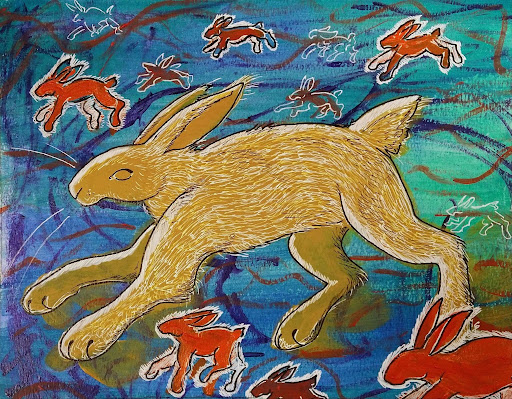
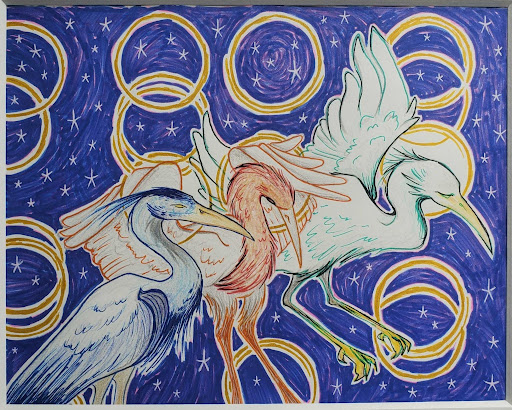
Her move to the creative world didn’t mean abandoning the environmental one. Growing up in Miami, Bee’s childhood was a masterclass in Florida’s ecology: her backyard sprung with mango, lychee, papaya, and coconut trees, and she grew up collecting rainwater and taking field trips to the cypress domes of the Everglades, where she swears if you stay quiet enough, you can literally hear the trees breathe.
When the opportunity arose to serve with CCEC, it felt like a match made in heaven, bridging her creative drive with her deep-rooted love for Florida’s landscape and the environment.
Bee’s CCEC AmeriCorps service is part of a legacy of environmental stewardship across Miami and the nation. Serving out of the Earth Ethics Institute at Miami Dade College, Bee supports the Kendall Campus’s organic garden. Students learn proper gardening techniques to grow various herbs and vegetables, including kale, various lettuces, and bell peppers, which are distributed among students and community members facing food insecurity.
Serving alongside Bee are fellow CCEC members Melissa and Angeline, who support the organic gardens across Wolfson, Kendall, Hialeah, and Padrón campuses. Also, through a partnership with Citizens for a Better South Florida (CBSF), Bee brings environmental education about city tree growth and community gardens to underserved communities across Miami.
Currently, the MDC team and CBSF are in the works of installing a new organic garden on the campus, which will be maintained by both students and the organization to further education on tree and plant maintenance and to attract and preserve native pollinators.
The work can get gritty. For Bee, a typical workday at the Kendall Campus garden starts at 10 AM, with the Florida humidity already settling in and the heat steadily rising. She spends her hours hauling heavy carts of mulch and engaging in a battle against invasive plant species enveloping the garden. She leads volunteers, providing plant identification training and explaining the ecological stakes of their removal.
In the world of conservation, some plants act like “boss-level” enemies rather than greenery. The hardy intruders near Miami Dade College’s gardens—snake plants, Brazilian pepper trees, Burma reeds, and air potatoes—block walkable paths and choke out the native vegetation that should be thriving. Bee and her band of fellow volunteers spend hours identifying and removing species that threaten the garden’s delicate balance.
Take the common snake plant, for example. While it looks sleek in a living room, in the Florida wild, it is an aggressive invader. It spreads through underground rhizomes, which don’t behave like typical plant roots. Instead, rhizomes situate in shallow parts of soil, spreading a webbed root system horizontally rather than vertically to go deeper into the ground. As a result, snake plants form dense, impenetrable mats that act as a biological desert, preventing native seeds from reaching soil and stripping the ground of nutrients needed by local flora.
“They’re so difficult to get rid of,” Bee explained, “because of how intricately [rhizomes] are embedded in the soil. You have to make sure all of it is uprooted—and with a whole colony invading an area, the rhizomes become so well developed and intertwined that even a little bit left in the ground is enough to let the snake plant regrow.”
That’s what makes snake plants incredibly resilient and nearly indestructible. What makes matters worse is that they thrive on little nourishment—they’re drought resistant and can live comfortably in low light conditions, making them a popular house plant for beginners.
Aside from snake plants, Burma reeds present a more explosive danger. They were brought over from India, Nepal, Taiwan, and Java by the USDA for erosion control, and eventually, as an ornament. These towering, grass-like stalks grow aggressively and contain a high amount of dry material, increasing the risk of high-intensity fires that can devastate local ecosystems. Burma reeds can grow over 10 feet tall and snuff out native vegetation in pine rockland habitats with their leaf litter.
Then there’s the air potato. This vine climbs high into the canopy and drapes itself over trees like a heavy green curtain. By blocking out the sun, it starves the trees underneath from the rays necessary to photosynthesize. Air potatoes reproduce through small, potato-like tubers that drop to the ground, meaning Bee’s work involves a meticulous search to ensure no seeds are left behind to restart the cycle.
Whether she is hacking through a thicket of burma reed or mulching a path to make it accessible for students, it’s all worthwhile and beneficial for the biodiversity near and surrounding Miami Dade College.
“You see the impact of the work immediately,” Bee said.
Next Steps: Nature’s User Interface
You might be wondering, “How does an Animation and Game Art major facilitate environmental stewardship?” For Bee, the answer is visual communication.
In the world of game art and design, players need a clear user interface to navigate a world. Without it, they get lost or miss the story. Bee realized the Kendall Campus garden had a similar problem: many of the plants were marked with nothing more than a nondescript stick in the ground, leaving their ecological importance invisible to the casual observer.
Bee has been collaborating with Melissa and Angie to design and implement new, high-visibility signage. She applies the principles of visual hierarchy to ensure that plant names and their uses are easily viewed and read by visitors. She’s also helped Citizens for a Better South Florida with redesigning several of their flyers and graphics for future volunteer events and info sessions.
Her goal is to bridge the digital and physical divide by including QR codes on the signs. These codes would link students and community visitors to a digital database about the plants, effectively turning a walk through the garden into an interactive, real-time learning experience. This system will take a major load off volunteers and EEI staff by eliminating the guessing game completely, dedicating more time to garden work and ensuring the garden is properly maintained.
Bee's vision for the MDC garden extends well beyond the soil. What began as a hands-on beautification effort—students gathered around tables, painting signs, bringing color and personality to the space—has grown into something more lasting: a digital database that will carry the garden's story long after any single volunteer moves on.
For Bee, that kind of tangible, community-driven work is the whole point. "The road to volunteering is different for everyone," she said. "Look around, get involved, and things will come to you. The internet is not the same as learning directly in-person."