 By: Mohammad Shedeed
Newman Civic Fellow, University of Pittsburgh
Published as part of Letters to America, a national youth-driven civic initiative launched by Made By Us through Youth250, in which young people put forward their own declaration for America’s 250th anniversary. These letters are published unedited and in full to showcase the students’ authentic voices and unique perspectives. While their views are entirely their own, we believe their voices, and those of all our student leaders, are a vital part of the conversation around America’s future.
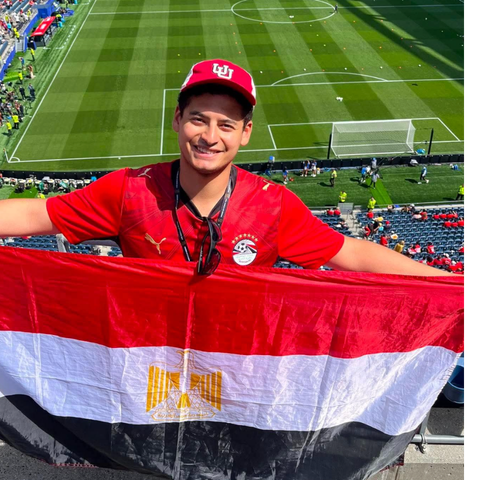
I had the privilege of attending a World Cup game in Seattle last week.
I am a huge soccer fan and it has been a dream to attend this event my entire life. Before arriving in Seattle, much of the conversation surrounding the FIFA World Cup centered on controversy: visa concerns, questions of leadership, and fears about security. Those issues mattered. Yet once I arrived, I discovered that large events are ultimately defined not by administrators or headlines but by the people who attend them. In a time when Americans often hear that our differences divide us, the World Cup reminded me that democracy depends on the opposite belief: that people with different identities can coexist, respect one another, and build community together.
The match was between Egypt and Belgium and my parents are both immigrants from Egypt and my Egyptian-American heritage is very important to me. I was wearing an Egyptian jersey on the day of the game and at the stadium a man was wearing a Mexican jersey and he saw I had the name Salah on my back. We started up a conversation. He mentioned that he had been living in Seattle for a couple of years and had come to the game for fun. He said he was a fan of Egypt’s star player Mohamed Salah and asked to take a selfie with me since he “loved to meet new people”.
During the game itself, the atmosphere was electric, but everyone remained respectful, even though rival fans were seated in the same sections, something that cannot always occur safely in other countries around the world. A couple wearing Belgian jerseys offered to take pictures of me and my dad at the game. It was a small act of kindness that reflected the welcoming atmosphere throughout the stadium to visitors from Egypt, Belgium, and several other countries.
The game was great and ended in a 1-1 tie and as we were leaving the stadium Belgian fans congratulated us on a great game in a great show of sportsmanship. As we walked a couple blocks from the stadium on our way to the hotel, another local who I later learned was of Indian ethnicity saw the Egyptian flag that I was holding and asked to take a picture with it as he had a lot of Egyptian friends. He also asked to take a selfie with me. Sports is one of the cornerstones of American culture, and the World Cup is built on the idea of bringing people together across national and cultural boundaries.
Despite all the problems and tensions we have in the country today, this event reminded me of the value of the people in America. The people I met reflected one of America's enduring ideals: that individuals from all over the world can come here, share their cultures, and build connections with those who are different from themselves. My own parents came to the United States because they believed this ideal, and the openness I witnessed in Seattle reminded me why so many continue to do the same.
As America approaches its 250th anniversary, it is easy to focus on political division and cultural conflict. I am not ignoring these issues but I think it is important to remind ourselves that beneath political disagreements and cultural tensions lies a capacity for connection that remains one of our greatest strengths. In a stadium filled with thousands of people from different nations, I saw another version of America. I saw strangers choosing curiosity over suspicion, respect over hostility, and connection over division. Democracy ultimately depends on these choices.
The future of America will not be shaped only by politicians or institutions, but by ordinary people willing to engage with those who are different from themselves and I can’t wait to work with others to improve our future.