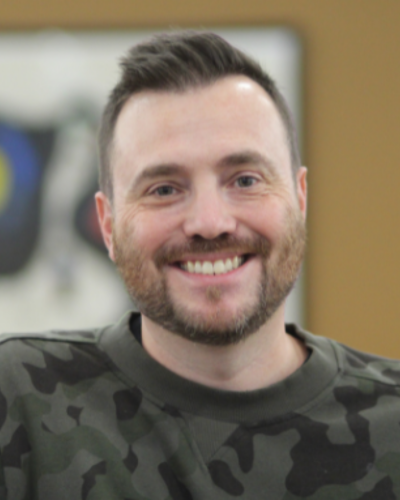
 Dr. Mathew Oakes is a Professor of English at Rock Valley College (Rockford, IL), a National Faculty member at CAST, and a 2023-23 Community College Research Network Fellow with Campus Compact. His focus is on equitable, civic, anti-racist, and universally designed curriculum development, teaching practices, and institutional policy. He sees teaching as a revolutionary act, challenging obstacles to empower individuals. Dr. Oakes contributes to the college community as a member and past chair of PAIC, LGBTQIA+ Safe Zone trainer, and UDL founding cohort member at RVC.
Dr. Oakes is one of five individuals selected to be a Campus Compact Community College Research Fellow for 2023-2024. His research has explored and elevated the essence of civic and community engagement within the RVC community, discovering insights and learnings that are relevant to similar community colleges across the country.
“Developing connections between my classroom and the community is a passion of mine,” said Dr. Oakes. “Being a Fellow with Campus Compact allows me to lead our campus in a discussion about how civic engagement is a central component of our students' learning.”
These audio essays [transcripts available below] are organized around three key questions:
- What does civic and community engagement mean to you?
- What does civic and community engagement look like in practice?
- What can prevent higher education from embracing its civic purpose?
These relatively simple questions open up insightful discussions and sometimes tough conversations with faculty and staff in a variety of functions. While these audio essays are specific to RVC, the themes, challenges, and opportunities on display are relevant to any community college with a new, longstanding, or revived interest in civic and community engagement.
Audio Essay #1
Audio Essay #2
Audio Essay #3
Special thanks to RVC faculty and staff who were interviewed as part of this project:
- Dr. Howard Spearman, President
- Rachel Boge, RAISE Program Coordinator
- Suzanne Miller, professor of Sociology
- Dr. Amanda Smith, Chief Academic Officer
- Cierra Morris, Workforce Equity Initiative Coordinator
- Dr. Bob Betts, Communications
- Dr. Michelle Rotert, Philosophy
- Jennifer Thompson, Executive Director of College Communications
- Denise Anderson, Engineering
- Patrick Peyer, VP of Student Affairs
- Dr. Luevinus Muhammad, Director of Student Life and Intercultural Student Services
- Dr. Danielle Hardesty, Philosophy
Rather read than listen? Transcripts below
Audio Essay #1
[Mathew Oakes]: All right. It is, February 19th, 2024. This is Mathew Oakes. I'm in the podcast room at the Estelle M. Black Library with the one and the only Dr. Howard Spearman. That's, I always do my podcast voice right then and then I don't do it anymore. Okay, so you asked me a question right before we started, and, can you ask it again? And then we'll then we'll dive in.
[Howard Spearman]: Yes. I was asking you, why are you into this and why is this important to you?
[Mathew Oakes]: I got connected with Campus Compact because, you know, they use language like the the public purpose of higher ed and the value of higher ed to democracy. And they talk about things like that and that that's always sort of been something that has struck a chord with me to think about, not just in terms of how education connects to individuals’ goals and ambitions, but also just like communities, goals and ambitions.
Right? Like what? How do we operate together as a society? And what is education's role in that intersection? And I think that community colleges in particular have this really special role to play in a number of ways. And this opportunity kind of came to me and I was like, what if I just took a bunch of time and I just asked questions like, what is what is this civic and community thing?
What is this? What have we? How does it work here on campus? What does it look like? What does it not look like? What it used to look like? What could it look like? And just that's it. And just ask a bunch of people those questions and see what everybody says, and then use it hopefully to create some kind of conversation starter or something.
To say, okay, I think we all do or do not share a common understanding around what these words mean and their value. How do we take the next step?
[Music Plays] [Mathew Oakes]: As one of four community college research fellows in 2023 - 2024, the brief from Campus Compact was attractively simple. As a fellow, take time to do something, anything that would be useful to advancing civic and community engaged learning on your campus and that compact could share across their network to support other community college practitioners. This series of audio essays emerges from the interviews I conducted with faculty and staff at Rock Valley College, which is one of Illinois's 48 community colleges located in Rockford, Illinois. In the interviews with my colleagues, I ask intentionally simple questions like what is civic engagement and what is community-based learning? With the goal of prompting my institution and colleagues, and perhaps yours, to live up to the mission of community colleges in the 21st century.
[Music Stops] [Mathew Oakes]: Feel free as we start talking through the questions to, answer them in any way, from any angle of your experiences at the college is one of the reasons I wanted to talk to you, because I think you've had a variety of, in a relatively short amount of time. You've seen a lot of nooks and crannies at the college.
So, so the first question, two questions are about these terms civic engagement and community engagement. And what I'm really trying to do is to tease out what those terms mean. For you, there isn't a right or wrong answer. The way I've been setting it up for other folks is to say, imagine you've got two circles. One says civic engagement and one says community engagement.
And you can either keep them separate as their own individual circles, you can make them overlap, or you can create some Venn diagram between the two of them. And just sort of talk me through what those words mean when I say civic engagement, community engagement, where do they overlap if you think they overlap?
[Suzanne Miller]: Okay.
[Mathew Oakes]: I started every interview with the same question, and it became instructive in understanding the range of previous experiences and context in which the terms community and civic are used across campus. Of course, the question is a bit of a setup, but it helped us crack open and explore the inner seams of these two terms. For some individuals, they realized pretty quickly that they use the terms synonymously.
[Suzanne Miller]: So. I guess it's hard for me to pull them apart because for me, they're they're almost synonymous.
[Amanda Smith]: In my mind. I don't know, like a clear... [Mathew Oakes]: Sure. [Amanda Smith]: Deviance between the two. So I feel like there's overlap.
[Cierra Morris]: I think it's parallel.
[Mathew Oakes]: But when prompted to discuss how we might consider what makes community engagement community engaged, they said things like:
[Suzanne Miller]: So, community engagement is supporting your community, whatever that looks like. And it could be something as informal as donating food to the local pantry to something super formal, like operating on boards or attending city council meetings.
[Bob Betts]: And community engagement is, it takes me to the local to like it makes me think of like the bake sale to get something done at a library.
[Michelle Rotert]: I imagine that we're talking about the creation of relationships. I believe that our lives should be about each other. So, this sounds, maybe this sounds silly, I don't know, but I don't, I don't meet a single person on this campus that I don't say good morning to when I get here. So. So there's that like even smaller circle. It's not even inside my classroom. It's the circle that's right, immediately around me, you come into contact with me I think it's part of my responsibility to be, to leave you better than I found you.
[Mathew Oakes]: As we zeroed in on a consideration of community and community engagement, all the participants discussed in one way or another, the ways in which we explore our shared humanity and, as a result, our corresponding shared responsibility to other humans. And as we teased out the ways in which our sense of civic responsibility sits parallel to community engagement, the conversation shifted. If our consideration of community prompted a reflection of how our work centers on the care and concern for others, our consideration of the civic prompted a reflection on how such care and concern bleeds into the practices of collective change.
[Jennifer Thompson]: But for me, civic engagement is a little bit more intentional about about, evoking change in the community that we live in.
[Suzanne Miller]: For me, civic engagement, when I hear that term, I think change, I think participation and I think change. And so even though like community engagement, that the word engagement means participation, whatever that looks like for you. Right? But that civic piece, to me, there's an educative component there that is all about, giving people the inforMathewion, they need to make informed choices. And that's where really that change piece comes in. Again, with community engagement change is involved. Because anytime you participate when you give food to a food pantry, you are creating change. When you when you stop and pick up that piece of litter that you see when you're taking your kid on a walk, that is change. But civic engagement. I almost feel like there's a more strategic and intentional approach.
[Denise Anderson]: How, how can we teach students to be productive members of their own community, to acknowledge needs and problems that they have, and then give them the skills and tools they need in order to, work towards solving problems together and doing it in a meaningful way for them personally. But for the community at large.
[Howard Spearman]: I think about, what type of influence do you want to have when it comes to, from, well, voting, elections, encouraging other people to be responsible citizens. Sometimes we hide in our community or we think in our communities that we don't have to be anybody else, but just, you know, individual in our community. But when it comes to citizenship, when it comes to civic responsibility, there's a, there's a, a level of influence that you have to decide where you're at on that, that concentric circle. Where are you, where are you at? You have rights and privileges, but it doesn't mean that you take full advantage of your responsibilities. I have the right privilege to vote. I have the right and privilege to be, ethical person in my community. What have you decided to do? How have you decided to use your influence?
[Mathew Oakes]: As we continue to discuss just what we meant by this term civic engagement, another term kept popping up out of the box.
[Patrick Peyer]: When I think about civic engagement. That's the stuff that I guess I would be inclined to think are the more, politically connected.
[Suzanne Miller]: Civic engagement. Even though I know this isn't true for me, there's almost a political component with civic engagement.
[Mathew Oakes]: So then when you hear the word civic, do you does it immediately, pretty quickly echo politics?
[Amanda Smith]: Probably only as like a gut reaction.
[Mathew Oakes]: The relationship between politics and our community and civic based work at Rock Valley College is something we'll explore later, but I think it's important to acknowledge it as the elephant in the room now. That unspoken dynamic of our engagement work that we, at least at RVC, don't as of yet, have a lot of practice integrating.
As a scholar and practitioner, I learned so much simply from asking my colleagues how they understand these terms civic and community. More importantly, as community college practitioners, we often do not have the space to interrogate these important questions together. But doing so is essential to the authentic pursuit of our shared mission. So, I'll reiterate the guiding questions and encourage you to spend time considering them with your colleagues.
In your own context, how do you understand the terms of civic engagement and community engagement? Imagine two circles, one labeled civic and the other labeled community. Are they separate circles? To what degree do they overlap? Should one circle contain the other? As you explore civic and community engagement within your own environment, what are your gut reactions and associations?
What do you make of these responses?
[Music Starts] [Mathew Oakes]: This project was supported by Campus Compact and Rock Valley College. Included in this recording are audio clips from my interviews with the following individuals from Rock Valley College, listed in order of appearance. Doctor Howard Spearman, president. Rachel Boge, RAISE program coordinator. Professor Suzanne Miller, sociology. Doctor Amanda Smith, chief academic officer. Cierra Morris, Workforce Equity Initiative coordinator. Doctor Bob Betts, communications. Doctor Michelle Rotert, philosophy. Jennifer Thompson, executive director of college communications. Professor Denise Anderson, engineering and Doctor Patrick Peyer, VP of student affairs.
Audio Essay #2
[Mathew Oakes]: As one of four community college research fellows in 2023 - 2024. The brief from Campus Compact was attractively simple. As a fellow, take time to do something, anything that would be useful to advancing civic and community engaged learning on your campus and that compact could share across their network to support other community college practitioners. This series of audio essays emerges from the interviews I conducted with faculty and staff at Rock Valley College, which is one of Illinois's 48 community colleges located in Rockford, Illinois.
In the interviews with my colleagues, I ask intentionally simple questions like what is civic engagement and what is community-based learning? With the goal of prompting my institution and colleagues, and perhaps yours, to live up to the mission of community colleges in the 21st century.
When you came here as a student and particularly a student athlete. What did civic engagement look like? Community engagement look like for you as a student athlete.
[Cierra Morris]: So, for me it was one person. I say I will always honor her. I mean, she's, one of the reasons I'm the leader who I am today, and a woman, call her my vanilla mama. Misty Opat. She's a cultural navigator. You know, that’s that person who's going to bring that civic and their community together. Because you need somebody in the middle to bring it together as well. And so, she was a cultural navigator for me. And that person who would stand up for me and fight for me.
[Mathew Oakes]: As I spoke with my colleagues about civic and community engaged work here at RVC, they would often respond to, as Cierra does, with a story about a person or a small program. Coach Opat stands out as someone who, as athletic director, intentionally drove our student athletes to connect their work on the court to their work in the classroom, on campus, and in the community. Of course, coach Opat is not alone. Colleague after colleague referenced that unofficial college hall of heroes who teach the whole student as a member of the whole community. And you can hear this very clearly in Doctor Michelle Rotert’s deep understanding of our students as humans nested inside of an expanding network of other humans.
[Michelle Rotert]: My primary job is in, is to create community in my classroom. But then then I also, you know, have the job to, create community within the college. But it's also legitiMathewely part of my job to create community, within the community.
[Mathew Oakes]: RVC's logo, nicknamed the Mark, is a set of three nested circles. And honestly, I hadn't ever paid it much attention until those I interviewed kept drawing on it as a symbol for the intentional development of a campus community.
[Howard Spearman]: Rock Valley. We have concentric circles, right, at the core, and every time you develop those relationships, it expands. Right. Well, when you realize that your relationships within your community continue to expand, you realize truly how directly you're connected still, to civic engagement.
[Mathew Oakes]: The individuals who understand their work in this way take very intentional steps to assume responsibility within their departments and offices.
For example, consider Doctor Luevinus Muhammad's description of how student life connects our students’ immediate basic needs to their inevitable impact in our community.
[Luevinus Muhammad]: So, I think about in my department, how we have a lot of students who come to our department daily who are hungry. So, we provide snacks to any student who will come up there at any given point in time.
But these are civic issues that they may be dealing with, hunger. We have students who don't have bus passes, a way to get to school. So, they can come by our office and get bus cards. They can get gas cards. And now we recently started doing Uber cards. So, you think about in terms of, supplying a need for these students who, have needs, so that they can flourish and be impactful in their communities.
[Mathew Oakes]: The more I asked about what civic and community engagement looks like here on campus, the deeper I came to understand that there's a contingent of individuals who take their work so, so seriously. Whether they're motivated by their own spiritual, philosophical, or familial frame of reference, these individuals understand that our own humanity is on the line.
[Bob Betts]: So buntu in English means people need people to be people. And it's not like our English term interdependence. It's more like, Mathew Oakes can't live, out of relationship. And so, the most important part about getting students toward a civic engagement mindset is the idea of, trying to, imprint upon them that you really can't live this life by yourself. That, that, if I want to become my most fully human, I can't do it, without you, without Paulette, without my colleagues on campus. I can't do it, without the stranger at the grocery store who, may ask me a question while I'm busy with my kids about Rock Valley or whatever. That, if I want to be my most fully human, I can’t just, like, sit on my island. So, for 20 some years, that that term has been on my mind about how it's due. Because people always say, well students always say to me, Oh, yeah, that's like interdependence. We study that in a business class. It's not exactly like that. It's saying that you can't be human without other people. It's not just, hey, let's all pull on the same side of the rope bit. My humanity is on the line. You know, and, if you believe that your humanity is on the line, then, then, then you have a responsibility to your, civically to the larger, world community.
[Mathew Oakes]: Yet, despite the very inspiring words and actions of so many colleagues, something seemed missing. Now, don't get me wrong. The individuals you just heard from deserve every accolade that comes their way. But what I didn't hear a lot about in my interviews was how we intentionally extend our sense that community engagement is something we do for our students by adding a strategic sense of community engagement as something our students learn to do. So then, a lot of the stuff we were just talking about is thinking framed in the way of the way that the college engages civically, or the college engages with the community. What how then, do you see the ways in which you can meet? Let's start with community engaged. The community engagement is something that we encourage our students to learn and develop as a skill.
[Amanda Smith]: Yeah, I, I think that is something that has yet to be fully developed. I think there are some ways probably, mostly through student clubs, I would think, we do more athletics does a great job in and student engagement or community engagement for students and so to some of our clubs.
[Mathew Oakes]: As you just heard from Doctor Amanda Smith, there's a clear sense that there's both a gap and an opportunity for us as a public community college to think more strategically about how to create learning opportunities that embody something like the idea of a buntu for all of our students across all of our noncredit and credit, courses, programs, certificates and degrees. I'd like to share a longer clip from a conversation I had with Doctor Patrick Peyer, VP of Student Affairs, and about 45 minutes into our conversation. We talked about how the opportunity to serve our community is so great here at RVC, precisely because the stakes for our students are so, so high.
[Patrick Peyer]: When we started this conversation, I mentioned the impact that I found available here in the community college setting specifically, honestly, in my opinion, at Rock Valley, I've only worked at one other community college, so I don't have a lot of depth to that knowledge. But the impact potential here is great. And when you help that student who's trying to understand financial aid or how to register or how to successfully pass this class, that they can't seem to figure out, when they get that stage or that completion, whether it's a, again, a short certificate that took them six weeks or that two-year degree that took them six years, it's a phenomenal moment for that family.
When they show up and they're begging for more tickets because four is not enough because everybody wants to come. Right. The family, the immediate family, the extended family, they all want to be there for this because it's that big.
[Mathew Oakes]: You sometimes, I think that folks internally and externally, whenever I say it this way, people are like, you know, you're I hadn't really thought about it that way, that if when you look at our district, district 511. We are the only institution of public higher education in that district.
[Patrick Peyer]: I know.
[Mathew Oakes]: The only one.
[Patrick Peyer]: That's crazy.
[Mathew Oakes]: And I think for all of, and then you look at the district itself, with all the dynamics you were just talking about, like, I it's one of the things that I talk about when I talk about why I'm motivated to do the kind of work that I do on this campus is like, if we don't do it, it's not happening.
[Patrick Peyer]: It's not. I know.
[Mathew Oakes]: If we don't do it, it's not happening.
[Patrick Peyer]: Well, we have institutions trying to claim angles in this to this district.
[Mathew Oakes]: But in terms of public higher ed, if we're not doing it, it's not getting done. And that's I think this is probably shared sentiment, that it's one of the reasons why working in a place like this is so rewarding. Because the stakes are so high. The payoff is so large, for many of our stakeholders. You know, you, you realize, like our students are, this is for many of them. This is their shot at a stable life.
[Patrick Peyer]: Yeah. That change in their families’ dynamic. For the long term. And then that that big role ripple effect. What frustrates me in this environment too, though, is, how easily a student can get derailed. [Mathew Oakes]: Yeah. Oh my gosh, it's so easy.
[Patrick Peyer]: It's so easy.
[Mathew Oakes]: As our conversation continued, Doctor Peyer and I described a twofold problem at our institution. One, that because our students needs always overwhelm our capacity to serve. It falls to individual faculty and staff to fill the gaps as part of their own civic and community engaged actions. And two, when we work to scale up community and civic engaged practices, we do so as acts of service to our students and not as opportunities for our students to learn how to be in community.
And there are only so many students that any one of us can fight for in that particular moment. I have a student right now, actually, we were emailing about the student last week. And I'm like, in my head every semester I pick a handful that I see at the beginning. I'm like, okay, no, I'm going to fight for you. But how many...
[Patrick Peyer]: How many can you fight for? There's 5000 of them and there's only a few hundred of us.
[Mathew Oakes]: Right. And, yeah, the stakes are high. The stakes are so high. And I think, that's one of the reasons why I think civic and community engaged learning can be such an important component for a number of reasons. One, we know it's a high impact practice, right? We know that it's going to help their student, the student success metric. But I also think it, it changes the way, it has the potential to change the way members of our community interact once they exit. Right. Because are we moving out of transactional or to a communal, relational, relational to ourselves? And like, I'm just going to go get my degree, I'm going to become a whatever I whatever, I'm going to go to work, I'm gonna cash my check. I'm going to home and watch me my Netflix. Right.
[Patrick Peyer]: My, my video games or whatever, yup.
[Mathew Oakes]: Which I mean, nothing wrong with video games, nothing wrong with Netflix. Right? But are we also that encouraging that that felt sense, like you were talking about your family and or just like, that's not the only thing you know, this, that the opportunities that are presented to you are ones that were created by other people.
[Patrick Peyer]: Right. And so we have to create it.
[Mathew Oakes]: We have to continue to create it. Otherwise, it all...
[Patrick Peyer]: And we're doing it. We're just not doing it on the scale to which we should be doing it. We are impacting many students. We are not probably impacting the majority.
[Mathew Oakes]: Yep, yep.
I'll end again with some of the guiding questions I posed to my colleagues and invite you to consider them with your own. What do you think civic and community engaged learning looks like? How has your institution invited students, staff, and faculty to pursue civically engaged or community engaged learning? How is it doing so now? How might it do so in the future?
[Music Starts] [Mathew Oakes]: This project is supported by Campus Compact and Rock Valley College. Included in this recording are audio clips from my interviews with the following individuals from Rock Valley College, listed in order of appearance. Cierra Morris, Workforce Equity Initiative coordinator. Doctor Michelle Rotert, philosophy. Doctor Howard Spearman, president. Doctor Luevinus Muhammad, director of student life and intercultural student services. Doctor Bob Betts, communications. Doctor Amanda Smith, VP of academic affairs and chief academic officer and Doctor Patrick Peyer, VP of Student affairs.
Audio Essay #3
[Music Starts] [Mathew Oakes]: As one of four community college research fellows in 2023 - 2024, the brief from Campus Compact was attractively simple. As a fellow, take time to do something, anything that would be useful to advancing civic and community engaged learning on your campus and that Compact could share across their network to support other community college practitioners. This series of audio essays emerges from the interviews I conducted with faculty and staff at Rock Valley College, which is one of Illinois's 48 community colleges located in Rockford, Illinois.
In the interviews with my colleagues, I ask intentionally simple questions like what is civic engagement and what is community-based learning? With the goal of prompting my institution and colleagues, and perhaps yours, to live up to the mission of community colleges in the 21st century.
To begin, I'd like you to hear from two of my colleagues, Denise Anderson in engineering, who you also heard from in episode one, and Danielle Hardesty in philosophy. Professor Anderson reorients us to the civic and community imperative at hand. Well, Doctor Hardesty poses an important question for us. What is preventing us from expanding our civic and community-based practices here at RVC?
[Denise Anderson]: How can we teach students to be productive members of their own community, to acknowledge needs and problems that they have, and then give them the skills and tools they need in order to, work towards solving problems together and doing it in a meaningful way for them personally, but for the community at large.
[Danielle Hardesty]: What is preventing us from being that creative and that unorthodox? Right? We used to have service learning, but it's kind of fallen off. There's no reason that we shouldn't have students more engaged with their local community. How do we, you know, debunk the the strict parameters of a class, right, in order to allow these more fluid ideas. And so, for me, I think that we need to be more creative to motivate our students to take the lessons when they learn and to act.
[Mathew Oakes]: Taken together, Professor Anderson and Doctor Hardesty cut to the heart of a few key ideas we've been roving around and through together. First, Doctor Hardesty orients us to what makes education a particularly humane field. That is our motivation for learners to be transformed with and by their education. To learn is not to perform or to regurgitate, but to make a dent in the world.
Second, both Doctor Hardesty and Professor Anderson remind us that as a community college, we carry the mission for both workforce and liberal arts and science education. And that mission ought to reach higher than a transactional agreement between the college and the economy for workers with a particular set of skill. At our best, our college ought to seek the transformation of the community, by the community, for the community.
Lastly, Doctor Hardesty asks, what is preventing us from accessing the kind of institutional and pedagogical creativity to construct a learning environment where that kind of community transformation is fostered. And it's this question that I want to take up. Before we go further, a note. Talking about barriers to meaningful institutional transformation is hard work and it's scary. I am endlessly grateful to the colleagues who spoke with me and shared their honest assessment of what the obstacles are here at RVC. In what follows.
You'll mostly hear me summarizing the words and ideas of our colleagues without identifying them by name. My intention is to identify the prescient themes that emerged from this section of my interviews. What we'll find is that while these obstacles emerged from a conversation specifically about civic and community engagement, they are also the barriers to other pressing issues on campus.
For those of us who have been on campus for more than a minute, we know at least two things to be true about RVC. One, this place is an incredible community asset. And two, we've got some stuff to work through. So if we take up Doctor Hardesty’s question in earnest, my assessment of the barriers to the kind of community and civically engaged campus culture are these:
One. We cannot create an environment with and for our students and community if we don't first create that environment with and for ourselves. When we attempt to do so, we borrow from a fund that is already in deficit. In the conversations I had with our colleagues who have been on campus for ten years or more, there was a clear three-part timeline we all silently acknowledged and understood.
There was a before when our campus community was strong. There was a middle when we walked through crisis after crisis. And there is a now, as we survey the wake of those crises and look forward.
In the before, our colleagues describe a period where faculty, staff and administration worked more collaboratively across institutional lines. There was a smaller total number of staff, and there was more space, both literal and figurative, for cross disciplinary and cross professional cooperation. For example, before the renovation of the student center, our colleagues described the former cafeteria space, a space I've never seen where students, staff, faculty and administrators routinely and organically connected and developed the relationships on which to build a curriculum and campus community.
Slowly, through attrition, facility planning, divisional reorganization and changes to decision making processes, that relational glue began to dry and crack. When asked about when our campus began to change, there was widespread agreement of a starting point in the early 2010s when our nonpartisan governing board of trustees found itself caught up in the political machinations of our city and county governments, seemingly becoming a training ground for future contenders for other elected offices.
And by the middle of the decade, a variety of forces added pressure. One after the other. In 2014, Bruce Rauner was elected as the Governor of Illinois, promising significant budget cuts, between 2016 and 2018, governor Rauner fulfilled his promise to reduce state spending, resulting in the Illinois Budget impasse, a 793-day long freeze on state spending. In 2015, our faculty union went on strike, and later that same year, the college laid off 30 staff and administrators while eliminating 14 more vacant positions, for a total reduction of 14% of the college's nonunion workforce. Those who were left were expected to do more with fewer resources, while also cutting and downsizing programs. 2016 saw the start of a new college presidency, kicking off what one interviewee described as, quote, the reign of terror, where the logic of zero-based budgeting collided with the volatile management.
In 2017, the reduction in force hit unionized tenured faculty members. When 28 faculty, almost 18% of the full-time faculty were laid off. Some were later rehired. Turnover in leadership accompanied all of these various crises from 2014 to 2020, RVC had three presidents in six years. A stark contrast to the only five presidents in the preceding 41 years.
Those same six years, on average, saw a new chief academic officer every year. While many more vice presidents and deans came and went. Like the rest of the world, the campus shut down in March 2020 due to Covid 19 and then, I kid you not, a tornado tore through our campus that August, just days before our current president started his term. And all of this under the shadow of the highly contentious and divisive national, political and cultural scene of the US since 2015. The image of a tornado cutting a scar through the heart of our beloved and beautiful campus is an apt image for the cultural moment we find ourselves in as a community. This place we love has been damaged and so have we.
We miss the people, programs and pine trees that gathered at the creek running through campus. We see signs of regeneration, but we are tired. We are hurt. We are angry and we are leery. Two, another block, to our community minded creativity is our diminished capacity to talk about hard things. As the cavalcade of difficulty washed over us in the last decade or so, we could often hardly find the words to process the moment, let alone the hours, the days, months, and years.
We moved on, but not forward. American corporate workplace culture teaches us to clock in, to smile, to produce, and to check out. But as many, many of the people I interviewed said, we are not a company and we are not beholden to that corporate logic that everything must only ever increase positively. We are, as doctor Bob Betts reminded me, one of the final locations of a third space in American culture.
We are neither a family unit nor a for profit driven workplace. Rock Valley College is a public space committed to lifelong learning within a free democracy and to preserve, exert, and expand this sense of ourselves in, with, and for the community. We must relearn how to say the things that are plain for all to observe, but which we've been conditioned to leave unsaid.
Naming the litany of crises and experiences is not easy. For these are the things we all know, but have been trained not to acknowledge. May this be a moment we courageously start to say the hard things without fearing repercussions. Three. Now, this isn't a uniquely RVC phenomenon, but we've gotten to a place where the civic components of our work, frankly, of our existence, have become fodder for partisan fighting, both locally, as well as, at the state and federal levels.
But of course, not everything that is civic is political, and not everything that is political is partisan, and it's important to recognize the direction in which the dynamics of power flow in that nexus of the civic, the political and the partisan. It is from the civic space, in other words, a space where unrelated humans find common cause and a sense of community.
It's from that space that power emerges. Politics is what happens when the community makes decisions about how to act together. Partisanship is when people convene into groups to organize and influence the politics of a community. I summarized my sense of RVC's purpose a few moments ago, and I'll state it again here for clarity. Rock Valley College is a public space committed to lifelong learning within a free democracy.
What worries me and many of my colleagues that I spoke to is that simply saying that sentence has begun to feel dangerously partisan and therefore unspeakable. I deeply resent this shift. In one of the conversations, I had. I noted a number of ideas which are relevant here. I'll replay them for you at length.
It's interesting. That idea that you just mentioned, the that and we are we have to be mindful of the fact that we're a public institution and we can't, we don't want to blow in the wind with the political whatever way the winds, the political winds are flowing. But I also wonder how the question goes the other way, too, as in terms of we are a public institution and so, what obligations do we have that are unique given when the winds do blow public institution should have certain values and principles that do not change. And so, it's not that it when the wind blows...
[Amanda Smith]: It should just stand straight.
[Mathew Oakes]: Which doesn't mean there's not friction. There is going to be friction of this because they're standing on those principles. And I think that that's going back to our earlier conversation around civic engagement. That in my mind, the way that I approach those items is its part and parcel of that human dignity piece, that it goes back to that big bucket I was talking about earlier about higher education, public higher education and American democracy. Is that part of my human dignity is preserved by the fact that I live in a democracy and not a dictatorship or authoritative communism or whatever it is.
And so, in addition to having in respecting my personhood, respecting my ethnicity, my sexuality, my whatever language of origin, part and parcel of that is teaching people how then to participate in the democracy that preserves those things. At RVC we have seven stated core values learner centered community, mutual respect, excellence, diversity, collaboration, innovation and public trust. These are civic values endowed to us by our community.
We should ground ourselves in them, nurture them, and let their roots grow deep. And if the conversations with my colleagues taught me anything, it's that perhaps we need to add two other values to this list. Honesty and courage. The honesty to openly account for what has been and what is, and what could be, and the courage to live our mission despite difficulty.
I'll end again with some of the guiding questions I posed to my colleagues, and invite you to consider them with your own. What barriers exist that keep you and your organization from embracing its civic and community-based purpose? What are your non-negotiable values? How can you live out those values with dignity, honesty and courage? [Music Starts]


Get Involved
Sign up for email updates below or follow us on social media to read more stories of impact on Campus Compact's community college member campuses. Or consider joining our community college affinity group, a network dedicated to preparing community college students to be informed, active, and mobilized leaders in our democracy.